
Presbyopia affects everyone as they age, but it doesn’t mean you have to resign yourself to constantly reaching for reading glasses. The contact lens options that are available today can help you see clearly at all distances, giving you the freedom to live your life without the hassle of switching between multiple pairs of glasses.
Keep reading to learn about the different types of contact lenses available for presbyopia and how to choose the best option for your lifestyle!
What Is Presbyopia and Why Does It Happen?

Presbyopia occurs when the natural lens inside your eye becomes less flexible over time. When you’re young, this lens can easily change shape to help you focus on objects at different distances.
As you age (typically starting around 40), the lens stiffens and loses its ability to bend and flex as easily. This stiffening is completely normal and happens to everyone eventually.
You might first notice it when reading small print becomes challenging, or when you need to hold books or your phone farther away to see the text clearly. Many people also experience eye strain or headaches when doing close-up work. The condition continues to progress gradually until around age 60, when it typically stabilizes.
Your eye doctor at Blaine Eye Clinic can evaluate your vision and discuss which presbyopia correction options might work best for you.
How Can Contact Lenses Correct Presbyopia?
Contact lenses designed for presbyopia work differently from standard single-vision lenses.
While regular contacts correct just one focal distance (either near or far), presbyopia contacts provide clear vision at multiple distances. They accomplish this through two main approaches: either incorporating multiple prescription zones into each lens or using different prescriptions in each eye.
The key is giving your eyes the ability to see both near and far without switching between different pairs of glasses. Some lenses do this by allowing both eyes to access multiple focal points simultaneously. Others assign each eye a different job, with one focused on distance and the other on close-up work.
Your brain plays an important role in making these lenses work effectively. Over time, it learns to select the right visual information from each eye and blend it into a clear image. This process happens automatically once you’ve adjusted to the lenses.
Multifocal Contact Lenses
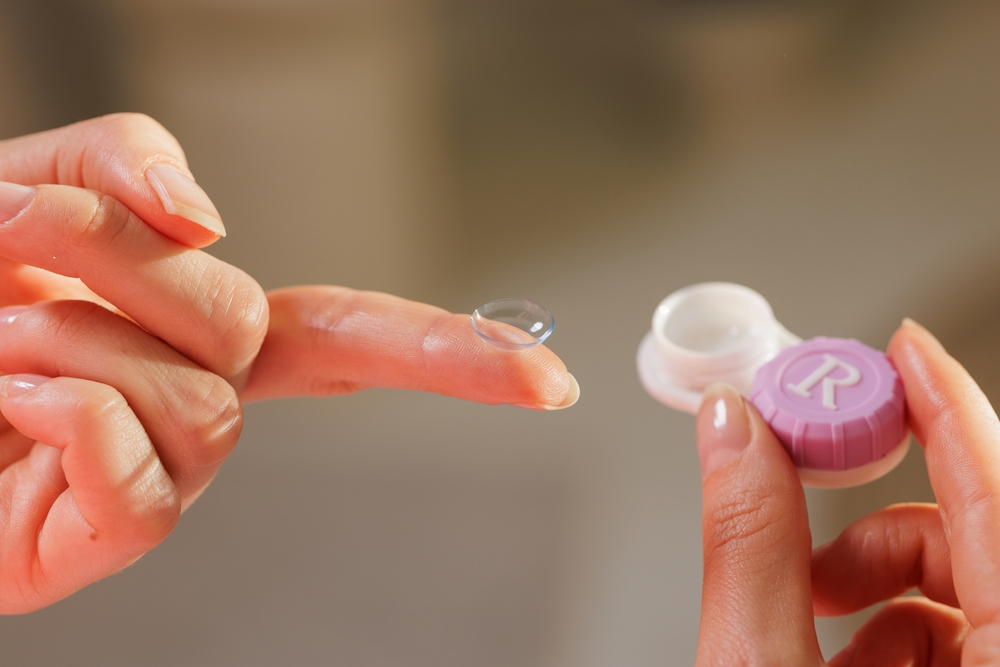
Multifocal contact lenses are another contact lens option for those with presbyopia. These lenses contain multiple prescription powers within each lens, similar to how bifocal or progressive glasses work.
They typically have different zones for seeing at various distances, with sections dedicated to near vision, intermediate vision, and distance vision. When light enters your eye, the lens provides multiple focal points, and your brain learns to select the right focus for whatever you’re looking at.
Multifocal contact lenses allow both eyes to work together naturally, which many people find more comfortable than other options. You can move smoothly between reading a book, checking your computer screen, and looking across a room without any conscious adjustment. The design lets you maintain depth perception, which is helpful for activities like driving or playing sports.
Most people adapt to multifocal contacts within one to two weeks of regular wear. During this adjustment period, you might notice some slight blurriness or visual compromises, particularly in low-light conditions.
Some people experience mild halos around lights at night. However, these effects typically diminish as your brain adapts to processing the new visual information.
Monovision with Contact Lenses
Monovision is a different approach where you wear a contact lens for distance vision in one eye (usually your dominant eye) and a lens for near vision in your other eye. Your brain learns to automatically use the appropriate eye depending on what you’re looking at.
When you’re driving, for example, your brain favors the eye with the distance lens. When you’re reading, it switches to favor the eye with the near lens.
This option works well for people who can adapt to having each eye focused at a different distance.
Good candidates are typically those who have tried monovision during a contact lens fitting and feel comfortable with how it affects their vision. The approach can be particularly appealing if you’ve struggled with the visual compromises of multifocal lenses or simply prefer a more straightforward lens design.
One advantage of monovision is that it uses simpler lens designs, which can sometimes provide crisper vision than multifocal options. The main consideration is that some people find it affects their depth perception or causes mild eye strain, especially during the adaptation period.
There’s also a modified monovision approach where one eye wears a multifocal lens and the other wears a single-vision distance lens, offering a middle ground between the two methods.
Which Contact Lens Option Is Right for You?
Choosing between multifocal lenses and monovision depends on several personal factors. The right choice varies from person to person, and what works perfectly for someone else might not be ideal for you.
Lifestyle Considerations

Think about your daily activities and visual demands. If you spend long hours working on a computer, you’ll want lenses that provide comfortable intermediate vision. People who drive frequently at night might prefer options that minimize glare or halos around lights. Active individuals who play sports often appreciate lenses that maintain good depth perception.
Vision Preferences
Consider how adaptable you are to vision changes. Some people adjust quickly to new visual experiences, while others prefer a more gradual transition. If you’ve worn single-vision contacts successfully in the past, you might adapt well to either multifocal or monovision options. Your tolerance for minor visual trade-offs also matters. Perfect vision at all distances isn’t always possible, so think about which distances matter most to you.
Eye Health Factors
Your eye anatomy, current prescription, and overall eye health all influence which contact lens options will work best. Some prescriptions are better suited to certain lens designs. The shape of your eyes might make one type of lens fit more comfortably than another.
The best way to determine which option will work for you is through a professional contact lens evaluation. Schedule a contact lens consultation at Blaine Eye Clinic in Blaine, MN, today to explore your presbyopia correction options and find the perfect fit for your vision needs and lifestyle.


